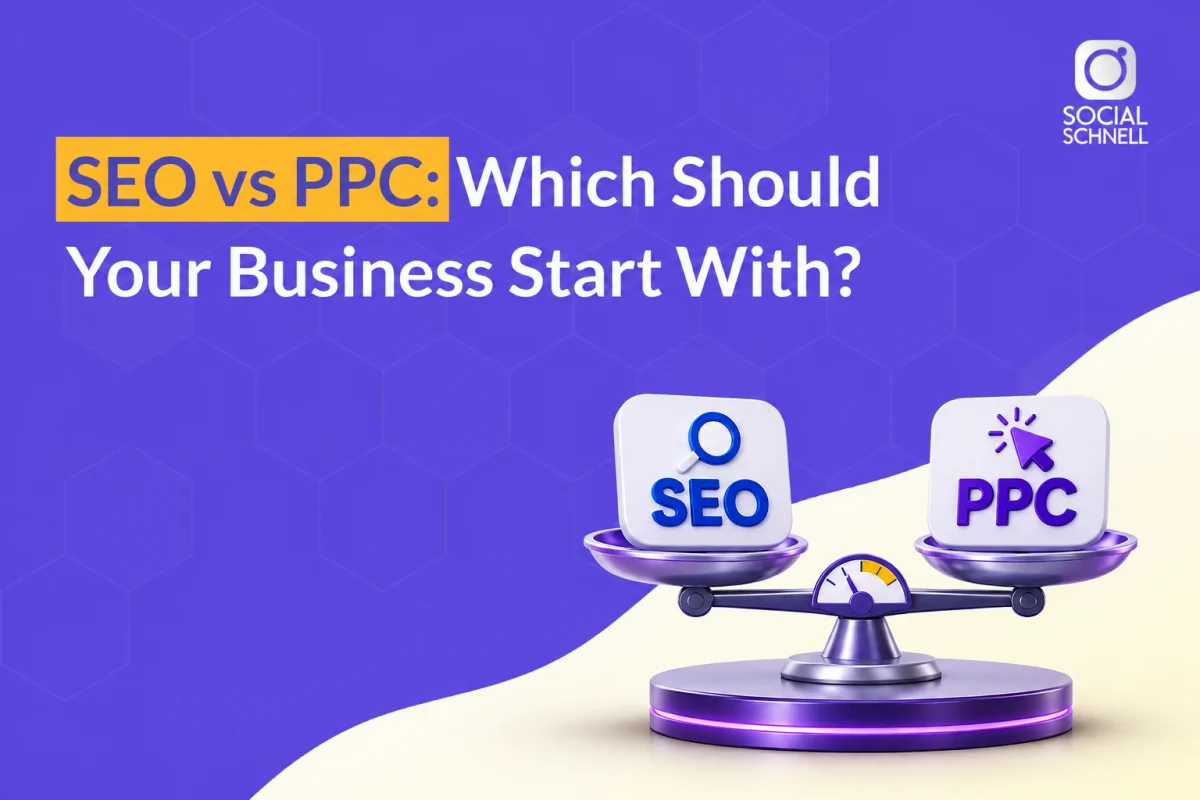
Website: SEO vs PPC: Which Should Your Business Start With?
By Priya, Head of Marketing, Social Schnell · Published 17 November 2026
Summary
SEO earns free clicks from Google’s organic results but takes months to build. PPC buys clicks from the paid results and can bring visitors the day a campaign goes live, but traffic stops when the spending stops. Start with PPC when you need leads now or need to test demand. Start with SEO when you can wait and want traffic that keeps coming. Most growing businesses end up running both.
Key takeaways
- PPC is fast and switchable: you pay for each click, and pausing a campaign puts your ads on hold.
- SEO is slow and cumulative: Google says some changes take effect in a few hours and others take several months.
- You cannot buy organic rankings. Google says advertising gives no ranking boost in Search.
- PPC search-term data is one of the best ways to choose which SEO pages to write first.
- Decide your split by stage: PPC carries the load early, SEO takes over more of it as rankings grow.
What is the difference between SEO and PPC?
SEO (search engine optimisation) is the work of earning a place in Google’s free organic results. PPC (pay-per-click) is paying to appear in the sponsored results, usually through Google Ads, with a charge each time someone clicks.
Both show up on the same results page for the same search, which is why the organic vs paid search question comes up so often. The difference is how you get there. With SEO, you improve your pages, content and site so Google decides you deserve to rank. With PPC, you bid in an auction for a place. Google’s own approach page says Search does not give ranking boosts based on advertising, so spending on ads does not lift your organic position.
| SEO | PPC | |
|---|---|---|
| Where you appear | Organic results | Sponsored results |
| How you pay | Time, content and specialist work | Each click, plus management |
| Speed | Months to build | Visitors from launch day |
| When you stop paying | Rankings fade slowly, if at all | Ads go on hold straight away |
| Best for | Long-term, lower-cost traffic | Fast leads, testing, offers |
How fast do SEO and PPC get results?
PPC can send visitors the day your ads are approved and live. SEO usually takes months before it brings steady traffic.
Google’s SEO Starter Guide says some changes might take effect in a few hours, while others could take several months. A new page has to be found, indexed and trusted before it outranks older pages.
PPC has no such wait. Once your campaign is set up, your ads can appear for your chosen searches immediately, subject to your bid, budget and ad quality. The catch is that speed costs money on every single visit. For a fuller picture of the SEO timeline, see our guide on how long SEO takes.
How much do SEO and PPC cost?
PPC costs you per click, so spending rises with traffic. SEO costs you in time and work, so the cost per visitor tends to fall as rankings grow.
In Google Ads, you set a maximum cost-per-click bid. Google says your actual cost is often less than that maximum, and a click will not cost more than the maximum you set. Your position in the auction depends on more than money: Google lists factors including your bid, the quality of your ad and landing page, and the context of the search. A better ad and landing page can win a good position without the highest bid.
SEO has no per-click charge. You pay for content, technical fixes, links and the people doing the work, whether that is your team or an agency. Those costs come first. A page written once can keep bringing visitors for years, so SEO often looks expensive early and cheap later.
What happens when you stop paying for SEO or PPC?
When you stop paying for PPC, the traffic stops. When you stop paying for SEO, the traffic usually declines slowly rather than disappearing.
Pausing a Google Ads campaign puts it on hold, so your ads stop showing until you turn it back on. No budget, no visits. That makes PPC a tap: very useful, but only while it is running.
SEO behaves more like an asset. Pages that rank keep ranking for a while after the work stops. Over time, competitors publish better pages and positions slip, so SEO needs upkeep to hold its ground.
Is SEO or PPC better for a new website?
For a brand new website, PPC is usually the better place to start, with SEO foundations built at the same time.
A new site has no history with Google, so ranking for anything competitive takes time. PPC gives you visitors and enquiries while that history builds. It also tells you, quickly and with real numbers, which searches turn into customers and which waste money.
Do not skip SEO while the ads run. Get the basics right from day one: a fast, mobile-friendly site, one clear page per service, accurate titles and descriptions, and a plan for the content you will publish.
Should a local business choose SEO or PPC?
A local business should usually start with local SEO, because a well-run Google Business Profile and local pages are free to show, then add PPC for the services that make the most money.
People searching for a clinic, a salon, a restaurant or a plumber nearby often see the map results before anything else. Showing there depends on your Business Profile, your reviews and your website, not on ad spend. For a business in Dubai Marina or Abu Dhabi’s Khalifa City, that free local visibility can bring calls without a cost per click.
PPC then fills the gaps. Use it for high-value services where one customer covers many clicks, for areas where you do not yet rank, and for new branches that have no reviews yet.
Which works better for seasonal offers and long sales cycles?
PPC suits seasonal offers, because you can switch it on for the season and off again. Long sales cycles usually need both: SEO to be found during research, PPC to catch buyers when they are ready.
- Seasonal offers: a Ramadan menu, a Black Friday sale or a summer camp has a short window. An SEO page may not rank before the season is over. PPC can run for exactly those weeks, then pause.
- Year-round seasonal pages: if the same season returns every year, build one evergreen page and update it each year. It gathers authority over several seasons, and PPC tops it up while it climbs.
- Long sales cycles: B2B services, property and high-ticket purchases involve weeks or months of research. Buyers read guides, compare options and come back later. SEO content answers their early questions; PPC on high-intent terms (pricing, “near me”, “agency”, “quote”) reaches them when they are ready to talk.
How do SEO and PPC work together?
SEO and PPC work best when each feeds the other: PPC supplies fast data on what converts, and SEO turns the winners into traffic you do not pay for per click.
- Use PPC search terms to choose SEO topics. Google Ads’ search terms report shows the actual searches that triggered your ads. Terms that bring enquiries are strong candidates for your next SEO pages. Our keyword research tips show how to turn that list into a content plan.
- Test headlines in ads before writing titles. The ad headline that wins clicks is a strong hint for your page title and meta description.
- Cut wasted spend with negative keywords. The same report shows searches that are not relevant. Google suggests adding these as negative keywords so your ad stops showing to people looking for something you do not sell.
- Reduce paid spend where you rank well. Once a page holds a strong organic position for a term, test lowering or pausing bids on it and watch total enquiries, not just ad clicks.
- Send both to the same strong landing pages. A page that converts well helps your ads and your SEO at the same time.
If you are also weighing up social ads, our comparison of Google Ads vs Meta Ads explains where each budget tends to win. And if you are considering Google’s automated campaign type, start with Performance Max explained for beginners.
How do you decide your split between SEO and PPC?
Decide your split by your stage and your cash flow, not by a fixed formula. Put more into PPC when you need leads this month, and shift more towards SEO as your organic traffic starts to carry its share.
- Work out what a lead is worth. Use your average order value or contract value and how many leads become customers. This tells you how much a click can cost before PPC stops making sense.
- Fund PPC to the level that covers your near-term targets. Start on the terms closest to buying, where the return is easiest to measure.
- Fund SEO steadily. SEO rewards consistency, so a smaller amount every month beats a large burst followed by nothing.
- Review every quarter. Compare leads and cost from each channel. As organic enquiries grow for a topic, move some of that topic’s paid budget elsewhere.
- Never cut SEO to zero to fund ads. That leaves you renting all of your traffic, with nothing building underneath it.
From our work
Social Schnell works as a long-term growth partner measured on revenue, not vanity metrics, with 9+ years of industry experience and $15M+ in ad spend managed for 15+ client brands. That is why it pays to plan paid and organic search together rather than as rival budgets: what matters is total revenue against total spend. Our free marketing audit includes a review of your website for user-friendliness, mobile responsiveness and search optimisation. For more on the SEO side, read how long SEO takes; for the paid side, read Google Ads vs Meta Ads: where your budget wins.
Quick FAQ
Is SEO or PPC better for a small business? Start with PPC if you need enquiries quickly, and build SEO alongside it. Over time, SEO usually becomes the lower-cost source of traffic.
Can I pay Google to rank higher in organic results? No. Google says Search does not give ranking boosts based on advertising.
How long does SEO take compared with PPC? PPC can bring visitors as soon as ads go live. Google says some SEO changes take effect in a few hours and others take several months.
Does PPC help SEO? Not directly, but its search terms report shows which searches bring customers, which helps you choose the right SEO pages to write.
About the author
Priya is Head of Marketing at Social Schnell, leading marketing across performance ads, social media, SEO and content for brands across the UAE, USA and Europe.
About Social Schnell
Social Schnell is a performance-driven digital marketing agency working with brands across the UAE, USA and Europe, with 9+ years of industry experience, $15M+ in ad spend managed and 15+ client brands.
Not sure whether to put your next dollar into SEO or ads? Book a free marketing audit and we will show you where it will work hardest.